100km van Ieper 2026
- David Hill

- May 18
- 8 min read
Tue 12 -Sat 16 May ‘26. DH, RW, PCL, AC, DL, JS
Day 1 by DL
At 9:15 am Tuesday 12th May 2026 our group of six slightly- retired bunch of friends from the now famous Saturday walking group set off in quiet excitement from Wincanton, the two cars first meeting at the Hunter's Lodge Inn before heading towards the Euro Tunnel.
The journey there was quick and largely uneventful due to good traffic conditions, though there was plenty of chat within the cars - on occasions concerning personal "bucket lists". We made a welcome comfort stop at Fleet Services, which included cake courtesy of Richard.
We arrived at Folkstone in ample time which, fortunately, meant that we could catch an earlier train to France. It's a while since I've travelled "le Shuttle" and I was amazed at how efficient it all was, with Boarder Control being much quicker than anticipated (only marred by a small delay caused by car breaking down as it was leaving the train).
France and Calais were soon left behind as we travelled southeast towards our destination - the tiny village of Sus St Leger. At this point "Walkie-Talkies" came into action and after a few trials and error check- in issues they proved to be very useful, especially once we left the main roads. The roads felt remarkably empty and villages and towns we passed seemed strangely deserted - but very French!
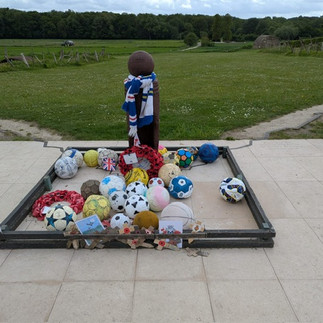
Sus-Saint—Leger is a small very rural village (with a population of under 400) in the Pas-de- Calais department in the Hauts-de-France not too far from Arras and about 20km from the Somme Battlefields. It was in this rural retreat that the "Ye Olde Game" of Shrovetide football was played along the main street of La Grande Rue by Soldiers from Ashbourne,Derbyhire.They were part of the 9th Platoon of C Company, 6th Battalion of the Sherwood Foresters who I believe were on R&R after an arduous period the year before. (The booklets we shared before our trip provides far more detail and I hope an insight to a long-forgotten occurrence played out on the streets on the 7th and 8th February 1916 in Sus-saint -Leger). Before our trip Dave had asked if anyone had a personal connection to events in the Great War to which our respects could be paid. The group knew of my annual pilgrimage to my former hometown of Ashbourne to participate in the traditional game of Royal Shrovetide Football and so I mentioned that the game had been played in Sus -Saint -Leger in 1916 on Shrove Tuesday and Ash Wednesday. Next, we were in the actual village and seeing where it really happened! On arrival we parked near the Church; not a soul was to be seen. I had asked a friend of mine to send an email, in French, to the Mayor of the village in preparation for our visit so that I might present him with a letter from the Ashbourne Royal Shrovetide Football Committee about the event that took place 191,6 but alas there had been no reply before our arrival. We walked to the War Memorial in La Grande Rue and wondered if we should place the presentation letter there. By now the second car had arrived and, after a chat, it was decided to knock on the door of the nearest house, to make enquiries about what to do. Dave and Richard took the lead here and once the knock was answered Richard spoke to the couple who answered in French and explained the situation. Although the occupants didn't speak English and our French was somewhat in need of some practise, we managed to come to an understanding and the Mayor was duly phoned. On arrival just a few minutes later (in a pick-up truck) the mayor was a little uncertain of our purpose, but quickly understood our purpose for being there and, duly honoured I presented the letter from Ashbourne Royal Shrovetide Committee which was then placed on the village memorial with two RGL wooden crosses in remembrance of those lads of Ashbourne who played their beloved game in 1916, all those years ago.
In those quiet moments, standing there at the Memorial in what was this very rural, very French village it was hard to comprehend about the events of those two days... who were they? What happened them? Did many come home? Perhaps some long distant relative I know nothing about! At that moment it really struck me what our visit was all about. Returning to the cars, we drove small country roads towards our night's accommodation, avoiding several tractors and fast-moving locals. After a drive of around 40 minutes, we arrived at Sommes Chambres d'Hotes in the village of Hamel.
Having settled in, we enjoyed a very welcome meal before making a sunset visit to the Thiepval Memorial, situated on top of a hill in a vast, open, rolling, agricultural countryside and visible for miles around. Again, it was hard to comprehend the events that took place here 110 years ago, especially with the sun setting and the night clouds rolling in over such beautiful countryside. It was very moving and thought provoking. Each of the group wandered around the memorial deep in thought, stopping occasionally to point out a name or to read the local register of remembered names, paying personal, silent respects. It was very poignant and humbling to be standing there in respect of those unknowns who had lost their lives in the events of all those years ago. A very moving experience. Following a very quiet walk back to the cars we made a visit to a small, very well-maintained cemetery where we could read the head stones and learn about those buried there — including a number from the Staffordshire Regiment and those Known Only to God.
Very close to the cemetery at Beaumont-Hamel was a very narrow, sunken, ordinary-looking farm track ( known as Hawthorne Ridge Redoubt ) which had run parallel to the German Lines and next to "No Man's Land" and where, on Sunday 1st July 1916, many of those soldiers were assembled, sitting, preparing to 'go over the top' and many of whom never saw the sun set on that day.
On returning to our accommodation, all feeling exhausted we and were very soon asleep.


Day 2
Sheffield Memorial inc Accrington Pals


Newfoundland Park


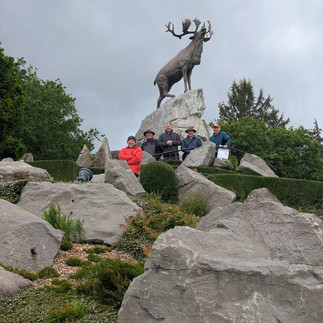
Vimy Ridge


Plugsteert




Day 3


10km walk


Paschendale Museum





Tyne Cot
Harry Patch at Pilcombe Ridge & German cemetery at Langemark



Mayors Reception in the Cloth Hall


Day 4
12 km walk
Popperinge, Talbot House and Shot at Dawn - RWs reflections
After witnessing such overwhelming memorials as Thiepval , Vimy Ridge , Tyne Cot and the Menin Gate and a number of smaller cemeteries marking the graves of thousands of individuals , we asked ourselves how the soldiers could sustain such terrible conditions and relentless exposure to death and destruction. What relief did they have from the squalor of the trenches and the pitiless bombardments and attacks which randomly killed or wounded their comrades.
We drove into Poperinge , now a peaceful attractive small town in rural Flanders which had the fortune never to have been overrun in the course of the Ypres campaigns. In the period 1914 to 1918 it was a hub for billeting soldiers behind the front lines, field hospitals were based there and it became a centre for recreation for troops in between deployment in the trenches. Recreation took many forms and there were no doubt flourishing bars, dance halls and brothels.
Talbot House or Toc H as the soldiers called it was founded by the parents of Gilbert Talbot who was killed in action in 1915. It had a very different aspiration from “entertainment” and was an Everyman House , welcoming all irrespective of rank and providing a calm place for relaxation , reading , reflection and companionship. The presiding host was Revd Tubby Clayton who was an army chaplain. The house remains today as a museum and guest house.
We visited Toc H having been profoundly shocked by the memorial to those shot at dawn by the British Army in the same town. Over 350 individuals were executed in the conflict and we visited two cells where many spent their last hours and read some of the accounts of their convictions and the refusal of senior officers to accept their pleas for clemency. The execution post remains as a bleak reminder of this terrible sideshow accompanying the greatest drama of carnage and sacrifice devastating Flanders in those years.
We entered Toc H via a small museum of memorabilia such as books , type writers , periodicals , pictures and photos with poignant letters home and reminders of Poperinge in more peaceful times. There was a reminder that Harry Patch and other veterans had made pilgrimages to the House in their later years. We then went through to the main house where we were immediately offered a cup of tea and the sort of welcome established by Tubby Clayton and still maintained today. Refreshed , we toured the building which still welcomes overnight guests and absorbed the atmosphere of serenity and healing among the books, pictures, photos and comfortable furniture from the past.
We climbed up a very steep ladder into the attic which remains a very quiet, special place. It was the Chapel and was visited by many thousands in search of encouragement and spiritual support in the time before they returned to the trenches. We were lucky enough to join a small group receiving a very good talk on the use of the Chapel and many interesting artifacts were explained. Most striking of all for me was the wooden cross which marked the final resting place of Gilbert Talbot before it was replaced by the ubiquitous Portland stone headstone. The cross is knocked about and eaten into with age but it defiantly reminds us of courage , self-sacrifice and loss…..
Afterwards, we were able to decompress in the beautiful gardens which lie behind the main house. There are benches to relax on , glorious trees and shrubs to take the eye and birdsong to lift the spirits… we can hope that these provided some comfort to those men in 1915.
Here is a quiet room.
Pause for a little space.
And in the deep’ning gloom
With hands before thy face,
Pray for God’s grace.
from “The Witness of a Wayfarer to Talbot House” by Rifleman Donald Cox (1917)
Chevasse, Spratling
Menin Gate
Day 5
Check out of SaBBajon
10km walk
Medals
Thoughts on the trip - JS
On the 12th, setting off for Folkestone, I wasn’t sure what to expect. Since joining this walking group roughly eighteen months ago every walk has been different. Quite uncanny, but amazing.
The trip through the Channel Tunnel was only about 30 mins, but very smooth. We were the last vehicle on the train, but unfortunately our disembarkation was delayed because the car at the front had broken down.
Once clear of the train we had a lovely trip to Sus St Leger. This was the site of a war time recreation by soldiers from Ashbourne. In this small village they relaxed from the pressures of war by playing their unique game of Shrovetide football. Deryck had researched this and was eager to present a framed certificate to the local mayor. An e-mail to the mayor didn’t draw any reaction. However, whilst resigned to leaving the framed document at the local war memorial, Red Leaderknocked on a door and with no French, used AI to ask how to contact the Mayor. This lovely family were amazing and rang the Mayor, who promptly turned up to accept the certificate from Deryck. Great result all round and a wonderful start to what I can only call an amazing week, like none other I have spent in my life time.
Like everyone I have visited my share of graveyards, but this was markedly different. The graveyards visited in the Somme and in the Ypres area had a wholly different affect. There was a sombre air. Thousands of grave stones representing thousands and thousands of people who all served their King and Country, sacrificing their lives in the process. I will never forget this experience
Dave planned the week perfectly with a great balance between remembrance, long walks, great evening food and much fun.
I was especially taken by our visit to Talbot House. A special memory. I was particularly taken by the loft converted to a chapel to serve the soldiers resting from battle. I can’t forget the amazing baptism font. It was miniature, but an amazing statement in the midst of battle.
A brilliant time Dave. Where next?
Return

Comments